If you have ever managed a building project—whether it’s a big, complex office space, a university lecture hall, or a massive public venue—you know one cold truth: labour costs are relentless. Every time a problem requires manual labour to fix it, money is spent. Active noise cancellation devices solve this issue efficiently.
Acoustics (sound) has been one of the largest concerns in residential or office areas for decades. The traditional method of producing ideal sound quality involved considerable manual labour: the construction of thick and specialised walls, the bulky absorption panels and the manual shifting of curtains and barriers to suit various events. It was static, complicated, and required lots of human hours.
But guess what? We finally have a smarter way to manage noise and sound quality. Acoustic automation is now available to handle these issues, not with lumber and drywall, but with software and intelligent sensing. This technology isn’t just about making a room sound better; it’s about making your entire operation cheaper to run by drastically reducing your dependence on costly manual labour.
Let us walk through exactly how upgrading to automated acoustic systems puts serious money back in your budget.
The Hidden Labor Cost of Traditional Sound
Before we talk savings, let’s look at why traditional sound control is such a labour sink. Think about a space that has to change its function often, like a conference centre or a flexible workspace.
- The Setup Labour: When the acoustics aren’t automated, changing the sound profile requires a team. A concert hall might need several people, taking half a day, to manually adjust dozens of heavy acoustic banners or reflector panels with acoustic noise cancellation devices for a shift from a rock band setup to a string quartet. That’s paid labour hours before the event even starts.
- The Maintenance Labour: Unlike lighting or HVAC, traditional soundproofing is passive. If a problem occurs—say, an echo appears after a desk is moved—the solution is physical. It means more contractor time, troubleshooting, measuring, ordering new materials, and paying for installation labour.
- The Reconfiguration Labour: This is the killer in modern offices. Open-plan spaces and modular meeting rooms are constantly being rearranged. Every time you move a partition, you disrupt the carefully balanced acoustic environment, forcing you to pay labour costs to assess and fix the resulting noise leaks or sound issues.
All this adds up to thousands of unpredictable, ongoing labour hours.
How Automated Acoustic Systems Slash Human Effort
Acoustic automation replaces heavy, static materials and guesswork with smart, flexible systems. The key to the labour cost saving is moving the heavy lifting from human hands to intelligent software.
Zero Manual Adjustment Time
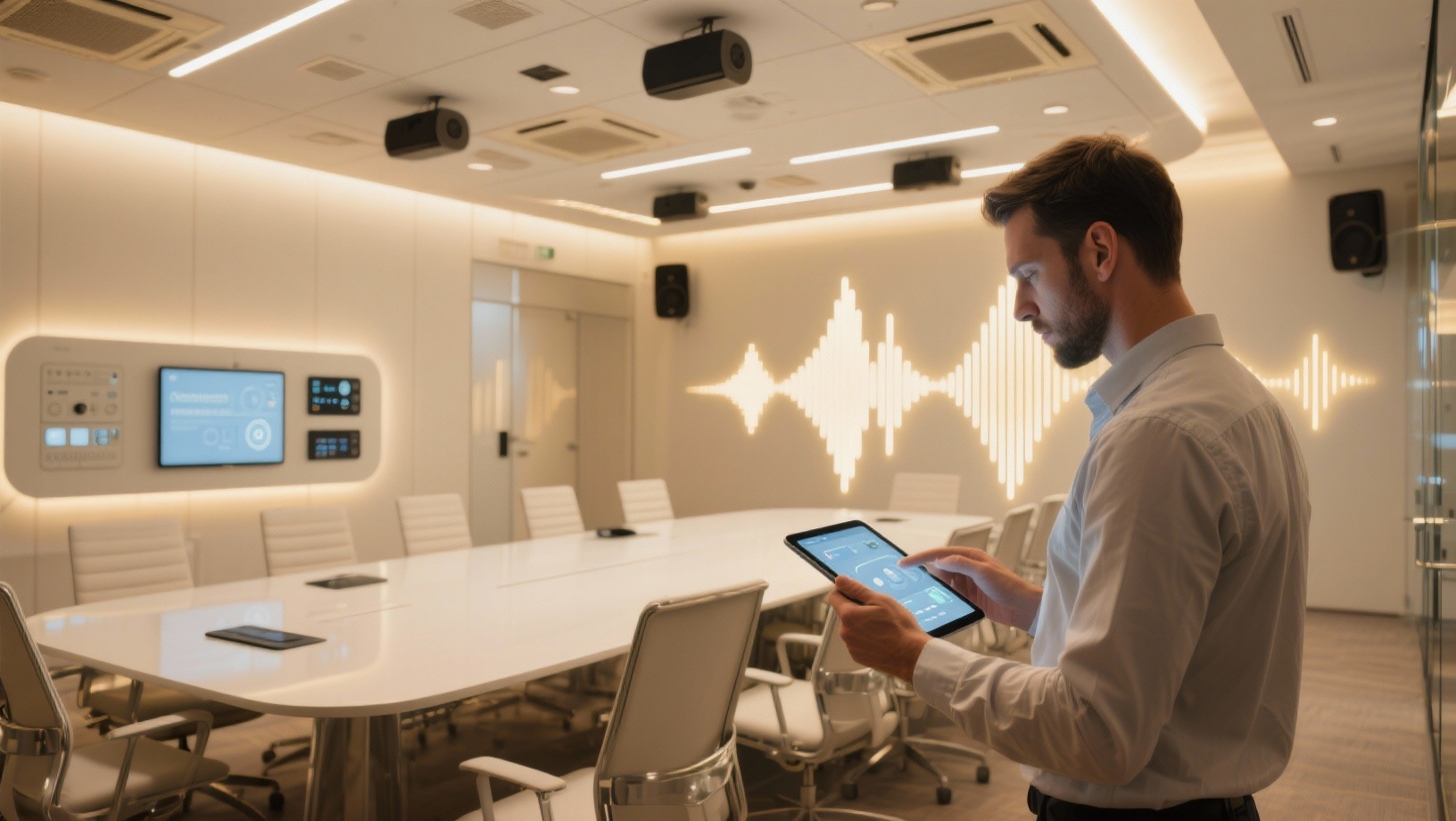
This represents the largest immediate savings. Automated acoustic systems with the help of ANC (active noise cancellation) devices, especially in complicated venues, eliminate the need to send teams into the physical space to adjust components manually—rather than paying three workers for four hours to climb ladders and move heavy gear, a building manager can simply press a button (or call up a preset scene on a tablet).
Example: The transition from a loud lecture setup to a silent exam setup in a flexible auditorium can occur in thirty seconds, using software. No labour time, ever.
Installation is simpler and reduces construction labour
Old-school sound insulation has specialised and expensive labour involved, such as layers of drywall, decoupled ceilings, and complex sealing of barriers. Automated systems such as sound masking can use simple and small speakers that can be installed above ceiling tiles or in the walls.
Installation of ANC devices is faster and simpler and can be completed by one general contractor or electrician (often quickly) rather than needing a larger crew to build complex noise barriers. Each process of installation can be much simpler than a time-consuming construction process, therefore saving you on construction labour from the start.
Remote management and bypassing onsite to troubleshoot
If a client complains of noise in Office 4B, your maintenance team previously would have had to walk into the space and then solve the problem. Once you integrate acoustic automation in your office, you can keep a watch on the issue in real time.
Future-Proofing Against Reconfiguration Labor
In the dynamic world of business, your acoustic needs will change. When a new tenant moves in or a team doubles in size, you would normally incur significant labour and materials costs.
An automated system saves you this recurring expense. If you move a wall, you don't need to rebuild the soundproofing. You just recalibrate the nearest smart acoustic nodes with a few clicks on a computer. This ability to instantly reconfigure the acoustic balance using technologies like acoustic noise cancellation, rather than through hammers and nails, makes labour cost savings a built-in feature of the technology.
Making the Smart Choice
Choosing acoustic automation is not only about quality; it’s a commitment to efficiency. It’s a decision to swap out unpredictable hourly labour fees for a reliable, one-time investment in smart technology.
The initial investment for acoustic integration might look higher than some basic setup, but once you start factoring in the eliminated labour costs—the daily adjustments, the constant fixes, the high price of contractors for every minor change—the automated system starts paying dividends almost immediately.
For any business owner or building manager looking to tighten their operational expenses, automating your acoustic environment is one of the smartest, most impactful changes you can make today. It’s time to stop paying people to move walls and start letting software do the heavy lifting. Looking for the best Acoustics Audio System Services near you? Kroire has got you covered.
FAQs:
1. What is acoustic automation and what is the difference between acoustic automation and traditional soundproofing?
Acoustic automation is the smart technology, including sensors, active noise cancellation (ANC), software controls, and so on, to control sound in a space. Acoustic automation has the benefit of being a flexible and cost-effective alternative to traditional methods, which often utilise heavy construction (e.g., soundproof walls or manually operated panels).
2. What is the cost saving in acoustic automation of a building project in terms of labour?
It eliminates the repetitive hand adjustments, costly constructions and reconstructions and maintenance. The rooms that formerly necessitated the crews to adjust acoustic configurations or troubleshoot noises can now be controlled remotely or reconfigured with software to adjust them immediately, which has dramatically reduced labour hours and costs.
3. Can automated acoustic technology be appropriate for both new buildings and retrofits?
Yes. Acoustic automation is able to be installed in new constructions or even fitted on the existing areas. Its lightweight materials, such as ceiling speakers and wall-mounted nodes, are simpler and less expensive to put up compared to conventional substances, making it feasible in both applications.
4. What are the best types of spaces to have acoustic automation?
The best-suited spaces are those with dynamically changing layouts or high acoustic needs, such as offices, universities, event spaces, conference centres and open-plan spaces. You can connect with Kroire today – the best acoustic company for the installation process.